The life Francesca Holland built
At about 3:45 on the afternoon of February 4, 1997, Francesca Holland left the Meals on Wheels office on South Haven Street in Baltimore. Her friend and co-worker Jacqueline Amatur-Raheem was the one who fixed the time. Holland was fifty-eight, the deputy executive director of Meals on Wheels of Central Maryland, and she had held that title for eight years inside an eighteen-year career that began in 1979 and ran through other positions on its way up.
The people she worked with described her afterward the way people describe a colleague who held a place together. Bob Schap, the executive director, said she "was a very upbeat person who always liked to look at the bright side of things." Joe Otterbein, the foodservice director, called her his friend as well as his supervisor, and remembered that she once went more than a year without buying another car because she enjoyed commuting on the public bus. She liked the bus, she said, because it let her be with and relate to people she would otherwise never have had the opportunity to meet. By that winter she owned a car again, a blue 1989 Honda Civic.
She was a convert to Islam, and to her fellow Muslims she was Halima Mujahid. Her family were Christians. She had two grown sons, Alan and David Bird, and a mother, Lillian DeHart, who still called her apartment in the evenings.
Home was the Brittany Apartments in Pikesville, where she had lived since 1987: Apartment 3B at 8 Montaigne Court. She kept cats, and her veterinarian, Dr. Michael Wiseman, described her as a loving, caring person whose visits to his office he enjoyed. Amatur-Raheem had known her since 1986. Colleen Gough said Francesca was like a sister to her and a mother to her children.
The morning of February 4 looked like every other morning. Alan Bird spoke with his mother, he believed from her work, and said she appeared fine and everything appeared normal. She left for work between six and seven, he said; her colleagues said she was usually at her desk between seven and eight. Her day-planner page for that Tuesday carries a single appointment, written diagonally across the day: "9 am meet @ Gail/Gaye" — "re: CA data collection." Below it a second note, which reads as written "Bal— out." That evening her mother called the apartment and got the answering machine.
There were plans for the next day too. After work on February 5, she and Amatur-Raheem were going to the supermarket together for a religious function.
At Meals on Wheels, eighteen years had taught her colleagues certain things about Francesca Holland. She was a conscientious and dedicated worker. She had never once simply failed to show up. And if she was ever going to be late or absent, she called, every time, to say where she was and why she was delayed.
The fear she put on paper
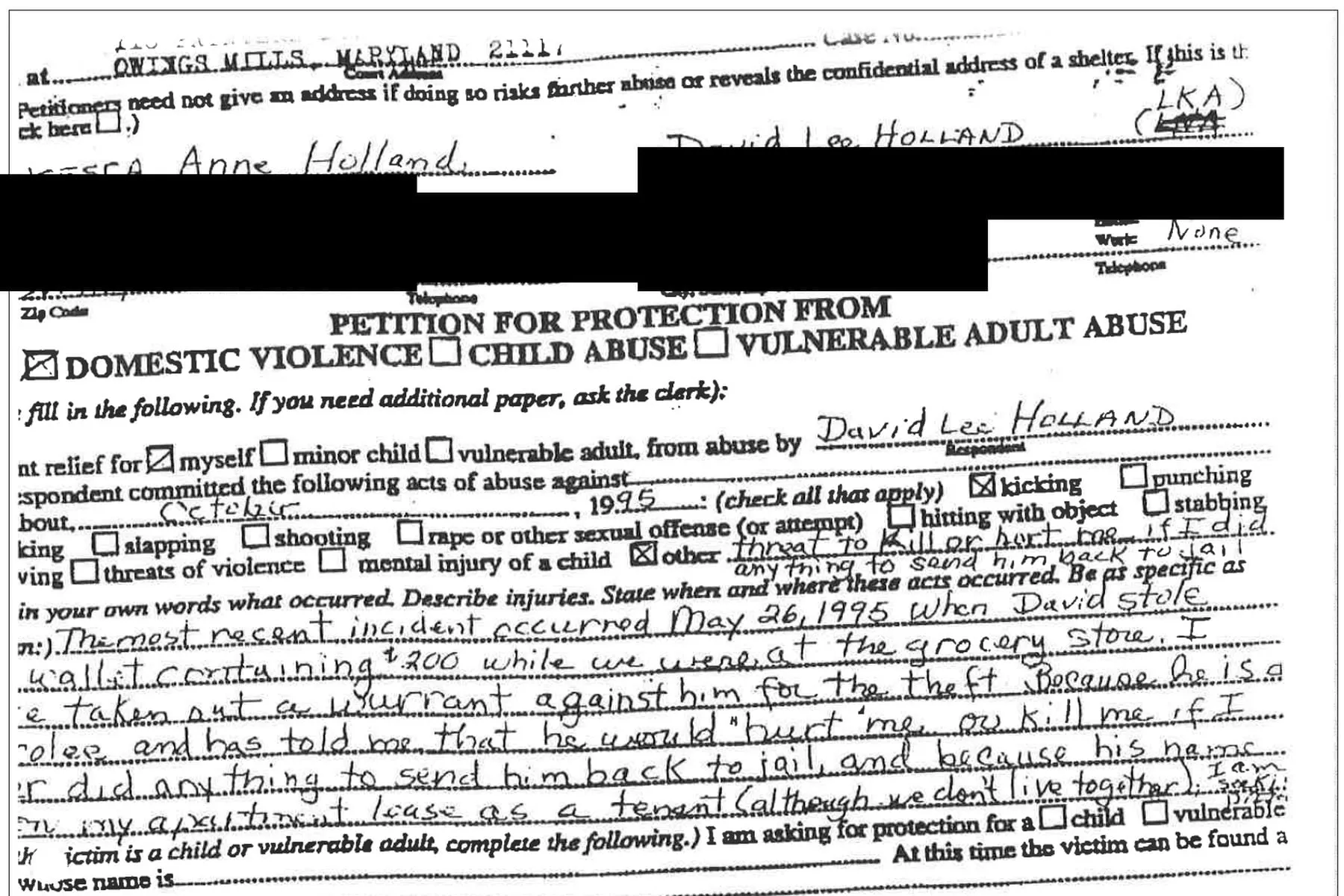
On May 30, 1995, Francesca Holland filled out a petition for protection from domestic violence in the District Court of Maryland, in her own handwriting, and signed it Francesca A. Holland. On the line asking her relationship to the respondent, David Lee Holland, the petition reads "Wife (estranged)." She wrote that he had been kicking her. She wrote that the most recent incident had come four days earlier, on May 26, at a grocery store, where he stole her wallet with $200 in it, and that she had taken out a warrant against him for the theft. She wrote that she feared him because his habits were violent, and that he had threatened to "hurt me or kill me if I did anything to send him back to jail." She asked the court to keep him away from Apartment 3B, and away from the building on South Haven Street where she worked.
A judge found reasonable grounds to believe David Holland had committed abuse and issued an ex parte order: he was not to abuse or threaten her, not to contact her, not to enter her residence. Then, in June, Francesca asked that the order be allowed to expire on June 15 rather than convert into a 200-day order. She told the court she no longer needed it, because David Holland no longer had access to her or her home.
The theft charge was eventually dropped. The phrase she had put on the petition, back to jail, had a record behind it. Reporting her death in February 1997, the Baltimore Sun noted that David Lee Holland had been convicted in 1975 of raping and robbing a 23-year-old art student and robbing her roommate at the women's downtown Baltimore apartment.
Access was something she kept working at. His name had gone onto her lease in August 1993; she had it removed. Leasing agents told police she came to the office about him on numerous occasions, expressed fear of him, and asked several times to have her locks changed. The agents also said he would ring her buzzer repeatedly during the night, waking the entire building. In roughly a decade at the complex, they reported, she had made no complaints except one, and that one involved her husband.
The people close to her heard the same fear in different registers. Amatur-Raheem knew about the restraining order, and said Francesca contemplated divorce but wanted to do everything possible to make the marriage work, and was afraid of how David would react if he learned of it. Francesca told her that David had said "he was going to hell so it didn't matter what he did." Karen Goods said Francesca told her the relationship was over, and that Francesca had no one else in her life; Goods also said David had once left Francesca at a grocery store, stolen her purse, and made her walk home after foot surgery.
Even the cats carried part of the record. Dr. Wiseman remembered treating them for several suspicious injuries, once for burns on their ears, paws, and tail, and said Francesca eventually admitted that David was home alone during the day and that no one else had access to the apartment. She told Amatur-Raheem he had slammed a closet door on the cat's tail and burned it with a lighter. Her son David Bird said the same: that David Holland tortured her cat, and that he stole her things and pawned them. Wiseman met David Holland exactly once and called him "the exact opposite" of Francesca's refined and gentle nature.
The divorce was finalized in November, according to records. In January 1997 Francesca called Andrew Kanaras, the lawyer who had handled it along with the protective-order matter, and asked him to keep the original records of her divorce and other legal documents. She told him she feared David was going to break into her apartment. On January 24 she attended the funeral of Colleen Gough's husband, arriving alone; she and David did not sit together, though she gave him a ride to the burial site and dropped him off somewhere afterward. She would not let him drive her car. He knew what kind of car she owned. Two days after the funeral she told Gough she planned to file a joint tax return with David and was considering giving him $1,000 from the refund. Gough discouraged it, believing he would waste the money.
Ten days after that conversation, on February 5, a maintenance worker at the Brittany Apartments lifted a bag out of a dumpster and found inside it the identification and work papers of the tenant in Apartment 3B.
A bag in an empty dumpster
Charles Brown drove a trash truck for Uhler Enterprises, and at about 5:50 that morning he emptied the three dumpsters at the Brittany Apartments. He said they were clear when he finished and that he saw no one near them. Later that day Bryan Couch, a maintenance man at the complex, went to dump trash and found a black denim carry bag sitting in the first dumpster. It was the only item inside, he said, and it was wet.
Inside the bag was a wallet holding Francesca Holland's Maryland driver's license, her checkbook, her date book, and at least one credit card, along with personal papers and work documents. Couch recognized the name of a resident, and the bag went to Helen Fox, the rental manager. Fox called Francesca's apartment and got no answer. She called Meals on Wheels; they had not heard from her. Then she called the police, and Officer Anthony Russell was dispatched to the complex.
Amatur-Raheem, reached through the leasing office, told police the bag was the same one Francesca had carried her important personal items in for the previous few weeks, and that failing to show up for work without calling was totally out of character for her.
Officers went to Apartment 3B. The bottom lock on the door was already unlocked; the deadbolt had to be opened by maintenance before Sergeant Ruth and Officers Mapstone and Kelly could go in. Francesca was not there. What they walked through was a life stopped mid-week: dirty dishes in the sink, overripe bananas on the counter and the window sill, dust on the tables with cat prints in it, kitty litter scattered around the boxes, books and mail on a bed that had covers but no sheets. Nothing in the apartment was broken. One message waited on the answering machine, and the caller-ID held two calls from February 4. The first was her mother's, the one that reached the machine. The second came from the Milford Mill Metro Station, and who placed it was never established. Her mailbox was empty when the post office delivered that day's mail.
By then the case had changed hands. Francesca had failed to arrive at work, her car was missing, and her personal items had turned up in a dumpster; district personnel notified the Homicide Unit, citing the suspicious circumstances and what a detective's report called her volatile relationship with her estranged husband. Her co-workers had already warned police about him.
The physical trail at the complex went quiet fast. Forensic Services processed the dumpster and recovered no latent prints of value. A K-9 search of the area around her building came back negative. What the complex did produce was a memory: Christina Bagheri, a rental-office employee, told Officer Kelly she had seen Francesca's ex-husband walking toward a dumpster with an object in his hand. She could not recall what day that had been.
The car was a blue 1989 Honda Civic, Maryland registration DWL 013. An early sweep from Sugarwood Circle down Honeywood Place found no such vehicle. David Holland had changed his address the previous September to 987 Honeywood Place, a townhouse in Essex. On the evening of February 5, a district unit found the Honda, registered to Francesca Holland, parked in the 900 block of Honeywood Place, approximately 118 feet from his front door.
The Honda at Honeywood Place
Officer Robert F. Bouder, Jr. sat on the car. It was parked next to a grassy area, facing north, pointed the opposite direction from every other vehicle on the block, and he kept a visual watch on it until a homicide detective relieved him at about 7:30 that evening. The night was cold and windy. Honeywood Place was a rental townhouse community, clusters of two-story homes with white siding, street-side parking, sidewalks running to the doors, the whole of it well lit by light poles. The fourth residence east along the sidewalk from the parking area was number 987, and while the patrol officer watched the Honda, detectives were walking toward that door.
A police dog settled the question of what the car was. K-9 Brutus alerted aggressively on the trunk and scratched at the pavement beneath the rear of the vehicle, and the handler saw why: a red liquid was seeping from the trunk onto the street.
Police seized the Honda and had it towed to headquarters for forensic processing, a detective following it the whole way. It left Honeywood Place at 4:30 in the morning and rolled into the Crime Lab's vehicle processing area fifteen minutes later.
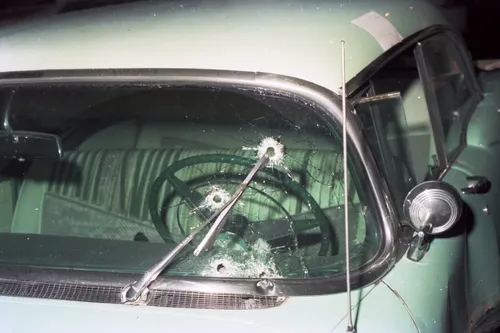
All four doors were locked. A dent in the left rear quarter panel did not look like fresh damage. Through the glass, investigators inventoried an ordinary front seat: a pair of gloves on the driver's-side dashboard, and on the passenger seat a box of Tastykake Cupcakes, a knit hat, a cloth-and-leather glove, a VCR tape, and a pamphlet. A Club anti-theft device lay on the passenger floorboard. Several leaves lay on the rear seat.
At 5:51 a.m., Officer Grunwell opened the car with a slim jim. Francesca Holland was in the trunk. She lay twisted on her right side, face down, her head toward the passenger side, her left arm bent at the elbow and turned back into her stomach with the palm up, her right arm under her body, her legs bent at the knee. She was fully clothed, in blue jeans over warm-up-style pants and white socks, a brown rain slicker covering her upper body, and she wore no shoes. Mud was caked over most of her clothing and her exposed skin. Under her were the floor mat from the front driver's side and the fuse-panel cover from beneath the steering wheel; the car's other mats were still in place. Around her sat the freight of an ordinary trunk, an orange snow shovel, a ten-pound bag of bird seed, quart bottles of motor oil, a Fram oil filter box, and, scattered through the trunk and across the back seat, leaves and vegetation, with soil on the front driver's floor and the rear passenger floor.
Forensic Investigator Dawn Zulauf arrived at 6:45, and at 6:52 the body was removed from the trunk. Both of Francesca's eyes were swollen completely shut. Severe bruising ran across her throat just below the chin. Blood was on her face and in her hair, soaked into her shirt, and soaked into the trunk carpet near where her head had been. Zulauf ruled that she had died as a result of violent trauma and ordered the body to the Office of the Chief Medical Examiner. The missing woman from Montaigne Court had made her last trip to police headquarters in the trunk of her own car, muddy, bruised, and without her shoes.
What police found at Honeywood
The knocking had started at about 7:45 the evening before. Detectives at the door of 987 Honeywood Place knocked for roughly five minutes and got no answer, while Detective Joseph O'Shea watched someone walk past an upstairs window, a person later identified as David Holland. The detectives pulled back, put the house and vehicle under surveillance, and planned to ask for consent to search, in the hope of finding Francesca alive.
At 8:25 p.m. they went in with a pass key from maintenance. Detective Milton Duckworth called out "Baltimore County Police," and a voice upstairs answered "Yes," then "just a minute." About thirty seconds later David Holland came down the stairs in a tank top and shorts and said he was fine, he had been in the shower. During the protective sweep, officers noted that the shower was dry, and that he did not appear wet. Francesca was not in the house.
He talked willingly. He said he had last spoken with Francesca by telephone on Monday, February 3, 1997, about taxes: they planned to file a joint return, and she was going to give him the $1,000 refund. He said he had last seen her on January 29 at her apartment. He said he had been home all day except for a bicycle ride to the McDonald's on Back River Neck Road. He agreed her absence was strange: "She usually won't miss work, that's unusual." He said he was unemployed and that Francesca had been helping him, that he lived with a new girlfriend, Monica Henson, and had never let Francesca know where he lived; when she gave him rides he made her stop before his neighborhood and walked or took the bus the rest of the way. Asked about her car, he said she might be driving a red Cadillac. Twice he denied knowing that Francesca was driving the Honda parked out front, and he told detectives he had never been in it and did not know she owned one. Later he told Detective Michael West he might have ridden in it a couple of weeks earlier, as a passenger. Both statements are his; they do not fit together, and the record leaves them side by side.
While detectives wrote up a warrant, surveillance watched him leave the townhouse carrying a dark plastic bag, enter the laundry room, remove something from a washing machine, and go back inside; later he walked out again with a dark plastic bag and an umbrella and sat on the bus-stop bench at Middleborough and Hartland. A property inventory from that night lists an envelope holding a BGE payment receipt in Monica Henson's name, recovered from a trash can at that intersection. A consent search of the laundry room seized nothing.
Police described his answers as evasive, and Judge Darryl Fletcher signed a search-and-seizure warrant at 1:52 a.m. When officers came through the door of 987 Honeywood Place, they found David Holland in the master bedroom with blankets pulled over him, in what the report called simulated sleep. At 2:55 a.m. Detective West read him his rights; he waived them and signed the card. At 3:10 he was under arrest. In the interview room, detectives recorded that he showed no emotion at any point. He asked whether he needed a lawyer, said he would get one later, and kept talking. He told them: "I am not a murderer," and "People say my wife is afraid of me; that's a lie." He said people who disliked him would want to frame him, compared his situation to the O. J. Simpson case, and then apologized for the comparison. When West called him a kept man he sat upright and argued loudly that he was not, that Francesca was going to give him money. "Why would I want to harm her, she was going to give me money," he asked. Near the end he laughed: "I'm going to roll the dice, and put my faith in God. If what you and Officer Joe (Detective O'Shea) say the forensics will tell, we will wait and see."
His alibi ran through his brother. He said he spent the evening of February 4 at Jerry Holland's house, slept downstairs until 9:30, took the 23 bus to Essex, and was home by about eleven. Jerry agreed that David was at his residence that evening and was alone when he left. But Jerry gave detectives two departures: in one account David left at about 9:30 the next morning, and in the other he left for their mother's between midnight and 1 a.m. and did not return.
Monica Henson filled in the rest. The lease was hers alone; David had moved in about two weeks after they met, and he did not work or contribute toward rent or bills. She last saw him at 6 a.m. that Monday, when he drove her to the airport wearing her silver-and-black coat. He did not come home that night, phoned her at work Tuesday midday, and did not reappear until Wednesday night at the bus stop; he never told her where he had spent the two days. She had asked him to wash some of her clothing on Monday. Her clothes were still unwashed; the clothes he had worn out of the house that day had been washed and were hanging damp on the dining-room chairs. Shown a photograph of the hat from the Honda's front seat, she said, "That's it, I bought it for him at the flea market on Patapsco Avenue." A glove found inside Francesca's car was hers too, she said; her gloves had been in the pockets of that coat.
The searchers carried out the coat itself, silver and black, from a dining-room chair, with the matching glove in a pocket. They took a key ring of nine keys on a leather thong from the dining table; weeks later, one of those keys opened the deadbolt of Apartment 3B, though none fit the bottom lock, and David had told detectives Francesca gave him two keys in late January because they were considering getting back together. They took white Fila high-tops from under the master bed, and beige luggage filled with videotapes that matched three pieces of American Flyer luggage sitting in Francesca's spare bedroom, where her entertainment center held VCR tapes, an open-ended cable wire, and no VCR. Henson said February 5 was the first time she had seen that luggage in her house; David said he had owned it since moving in. And from the metal strip where the kitchen met the dining room, an investigator swabbed a reddish stain.
The conviction and the unanswered details
The autopsy listed the cause of Francesca Holland's death as strangulation and the manner as homicide. An early police account said she died from being beaten on the head, and the examination of her body did show blunt force trauma to the head and face; the strangulation finding and the early account both remain in the record.
The forensics David Holland had gambled on came back through the spring. Human blood was identified on the black coat in three places: on the logo at the left wrist, at the left mid-arm, and on the label inside. Human blood was identified on the knit cap from the Honda's front seat. Blood was indicated on the instep of the left Fila tennis shoe, in a quantity too small for further testing, and on four fragments of Francesca's right fingernail clippings, also too little to test further. Much of the rest was negative: the kitchen-floor swab, the gloves, David's sweatshirt, pants, and left boot, the blue face mask.
Cellmark Diagnostics ran PCR testing on a cutting from the coat against known blood from David and Francesca Holland. The DNA in the stain came from a female. David Holland was excluded as its source. Francesca Holland could not be excluded, and the tested types occur in roughly one in 840 Caucasians, one in 12,000 African Americans, and one in 2,400 Hispanics. Detectives asked Monica Henson for a blood sample to verify the blood on her coat was not her own.
A latent-print examiner identified three prints from the car, the car David Holland first said he had never been in, as his: from the inside driver's door handle and the driver's-side exterior. Pawn records added the morning he had accounted for as a bus ride home. A police report stated that two pawn records showed David Holland pawning items on the morning of February 5, timing investigators considered inconsistent with his statement, and possibly involving Francesca's property. She had bought a Fisher portable stereo, serial number 1M66743, at Circuit City on January 5. Pawn records showed a Fisher stereo bearing that serial number pawned at Old Town Loan & Jewelry at 11:10 that morning, and a document examiner determined that David Holland had signed both pawn sheets himself.
He was charged with first-degree murder, felony murder, and robbery, and held without bond at the Baltimore County Detention Center. Francesca was buried from the Masjidul Haqq mosque in Baltimore; her family, Christians, wanted her buried according to the religion she had chosen. People of different races, religions, incomes, and ages filled the funeral. Joe Otterbein walked into a mosque for the first time in his life that day, and said her murder shook him to the core. At the office on South Haven Street, Faye Carey said, "We are just devastated and shocked by this," and called the death "a great loss to us." Francesca's last Meals on Wheels time sheet covers the pay period from January 26 through February 8, 1997: 47.5 regular hours, 4.5 sick.
In the homicide file, alongside the lab reports and the latent-print cards, sat the May 1995 protective order, the paper on which Francesca Holland had written in her own hand what her husband said he would do to her if she did anything to send him back to jail. He went back. David Holland was convicted and sentenced to life without parole, and the record never identified the weapon used against Francesca Holland, and never established a motive.