The Girl at Anini Beach
The pink Wizard bicycle had sixteen-inch wheels, a bike built for a rider not much taller than a doorknob. Police logged it into evidence at the west end of Anini Beach Park at 11:25 that night, and the receipt gives the reason in a single line: it was the last item observed in contact with the missing girl, and a dog would need her scent.
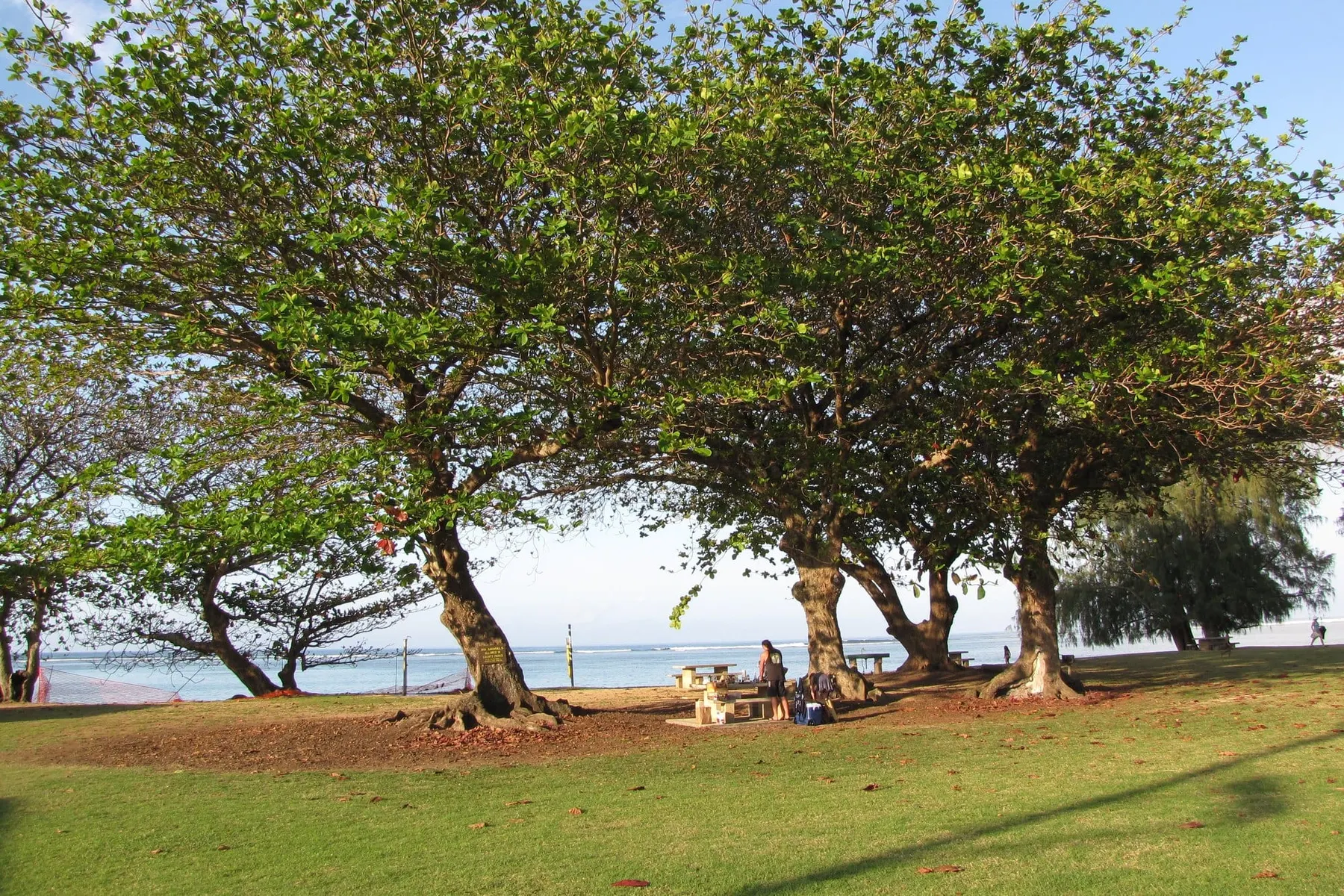
The girl who rode it was four years old. Hurricane Iniki had crossed Kauaʻi the year before and put many families on hard times, and hers was one of them. After the storm they lived in tents at Anini Beach, among locals and visitors doing the same. The address that went onto the police report was General Delivery, Hanalei; in the space for an alias, the event report carried the words "MISSING PERSON." Her mother was at the beach with her. Her father, Timothy Woolsey, was living on the other side of the island.
What the family kept at the park would later be itemized on a police receipt, after a caretaker gathered it up and turned it in: a Bible, clothing, two dolls, a blue lunch box with a thermos, pairs of children's shoes, a birth certificate, a red doll house.
Three more dolls went to the police that first night, collected so the search dogs would have something of hers, and the receipt describes them one at a time: a blonde-haired doll in an aqua-and-pink fluorescent dress, about nine and a half inches; a pink mini-mini doll with a blue-eye design; a blonde-haired doll with lace, about nine inches.
The ground itself comes through in the reports and photographs: tents pitched at the edge of the beach, Anini Road and a parking area just behind them, restrooms at the northwest end of the park, a pair of public phones, a bridge on Anini Road with a dry-bed entrance, a reef offshore.
On the evening of July 27, 1993, she was riding the bicycle in a long pink muumuu. The missing-person report says she was last seen running her bicycle about fifteen minutes before police arrived. The all-points bulletin put the last sighting at 6:40 p.m., stated that no foul play could be determined, and raised the possibility that she had wandered to the water. Her mother made the report.
At 7:15 p.m., Officer E. Keoho radioed for help searching for a four-year-old girl who had been missing for the preceding hour. Fire Captain Frances Noguchi was asked to organize a search at the park, and within minutes one was moving through the campgrounds, along the ocean front, and out into the surrounding area, officers questioning witnesses and taking statements as they went. Before midnight, an officer went to the family's tent for clothing the girl had worn, and a pink muumuu joined the bicycle in evidence, for the dogs.
Across the island, Timothy Woolsey's telephone rang. It was the police, asking whether he had his daughter. He did not. They told him her mother was at Anini, and when he got there he found them assembling a search party.
At 7:45 p.m., Sergeant Hans Martins was reporting a four-year-old child missing from the Anini Beach camping area.
The Search Moves From Land to Water
By full dark the search had police, firefighters, and the other campers moving together through the park: the campground, the tents one by one, the beach, the mauka side toward the hills. The first officer on scene had already walked the shoreline in front of the family's campsite and held there waiting for backup. Fire personnel worked under Captain Noguchi. Lieutenant Hurley, Sergeant Victorino, and officers from two sectors arrived, were briefed, and swept the area again. The findings were negative.
The leads were the kind a dark beach produces. Five fishermen told an officer they had been on the water since five o'clock and had seen neither a man nor a girl matching the descriptions. One report described a male walking out of the water, twenty-five to thirty years old, medium build, sandy-haired. A witness reported a man crossing a yard, possibly carrying a child, but could not identify him or say where he went. A mother stopped an officer to say her daughter had seen someone walking along a beachfront property at about five o'clock, toward the daughter's campsite. The reporting officer went looking for a male subject and could not find him.
At the public phones by the camping area, a man stood on the beach side, on the line with police dispatch. Officer Ford reported that the man had information about the missing girl's location and did not want marked police vehicles in the camping area. When a plainclothes officer walked up and asked whether he had called for a policeman, the man nodded, told the person on the other end that a plainclothes policeman was standing there, and handed over the receiver. A dispatcher told an officer the caller claimed information concerning a possible abduction and murder of the missing child. He said he wanted to cooperate.
The search was called at about one in the morning, to resume at first light, with helicopters to assist at daybreak. Timothy Woolsey did not stop. He spent the night searching the mountain for his daughter and did not find her.
At daybreak Lieutenant Hurley went up with Inter-Island Helicopters and flew the coastline from the campgrounds to Sea Lodge in Princeville, checking the reef and the shoreline while police and fire personnel worked the coastline and the water below. The aerial search showed no body in the water.
Then the water gave up the first thing. Firefighter Edson Martin found the child's panties about fifty feet offshore, in roughly seven feet of water, on a rock. They were white, size 4, with pink and blue ribbon designs.
To Timothy Woolsey the discovery said one thing: his daughter was in the water. He put on goggles and fins and searched the reef himself. He and another searcher swam out, about a quarter mile north of the rock, and went down into some forty feet of water, and there, on the bottom, he found his only daughter.
The Statement at the Station
Officer Jeff Hashimoto, Officer Robert Ford, and Officer Zack Okamura waited for an unmarked vehicle, so as not to alarm the man they were about to take. Sergeant Grant Yata had passed the word that dispatch had a caller at Anini Beach Park claiming to know about the missing child, and the caller told dispatch that the subject responsible was hiding in the bushes, waiting for the Iniki bus. A description came through: white pants, blue shirt. Hashimoto waved the bus down. Ford went in through the front and asked the man in white pants and a blue shirt to step off. The bus was bound for the airport.
At the Hanalei sub-station, at 6:25 on the morning of July 28, Aaron Schonlau was arrested for second-degree murder, with bail set at $20,000. A constitutional rights form carries his signature from that same minute. The form records that he acknowledged his rights, indicated he did not want a lawyer then or during the interview, indicated that no promises, threats, or pressure had been used, and signed beneath a printed line: "I AM WILLING TO ANSWER QUESTIONS AND MAKE A STATEMENT." The same form records that he indicated he did not want to tell the interviewer what happened or what he knew.
What happened around that form is told two ways. The interview account has Schonlau saying at first that he wanted a lawyer present, and later saying he was willing to answer questions without one; at one point he said he wanted a lawyer for questions that could personally incriminate him, because he was "in the wrong place at the wrong time." A later account of the transcript says questioning continued after he asked for an attorney. The waiver and the request both sit in the record.
His First Account
The man across the table was twenty. He said he had been in Hawaiʻi about a month and a half and at Anini Beach a week and a half, living in a tent, and before that on the Napali Coast, on Molokaʻi, on Oʻahu, in Tijuana, in Washington, in Colorado. He went by "Cockroach" and sometimes used other names because, he said, he was tired of using the same one. Work: "Not right now, not presently." His last job had been labor in plastics, "stuff they make for the hospitals," he said, "plastic cups, urine cups and things you throw up in." In the previous twenty-four hours, by his own accounting: Crown Royal, Budweiser, "some other whiskey I don't remember what it was called," marijuana, and mushrooms he picked in a field and ate. He had a headache from the drinking. He told police he had been off lithium.
His first account had him partying that evening with a group he called "the hippie guys, scratchies": three people and a silver van with a sliding door, two men playing brown Gibson guitars, a woman dancing, a little girl playing with stuffed dolls near the van, dogs running loose. A man at the campsite told him "your brother went diving," and he said he thought, "that's crazy, he's drunk." He said the girl and the dogs followed him when he walked off to look for his brother, that he crossed a bridge, passed a house, looked at the ocean, and came back to camp alone. He denied causing the girl's death. He said he had stayed inside his tent during the search because he did not want to deal with the police, having a charge already.
He could describe the drawers in a stranger's van and the gray streaks in a man's beard. The hour of his own walk would not hold still: with the hippies at 7:00, or 7:15, or 7:30; away at about 8:00; back at 8:15 or 8:30. He said he could not time any of it because he had no watch. The bulletin had put the girl's last sighting at 6:40 p.m. Police would later allege the offense occurred between 6:58 and 7:30.
The interviewer told him that more than two hundred volunteers, firefighters, rescue workers, police officers, family, and friends were out looking for the girl, and that her mother still hoped she was alive. "We're not blaming nobody," the interviewer said. Schonlau said he heard voices. He said a voice told him, "That I'm gonna go hurt somebody." Asked whether he had carried out what the voice wanted, he answered, "I must have." Asked whether he thought the girl was in the water: "Yeah."
The Account Changed
Then the account changed. "She followed me over there," he said. Where: "Under the bridge." He said he told her, "hey, come here," and that she came down willingly. He said he hit her, pulled off her pants, and tried to rape her; that there was no penetration, though he believed he used his finger; that he held his hand over her face while she screamed, and she stopped breathing; that he twisted her neck. He said he carried her into the sea, put her down, and put a rock on her shirt to keep her under, in water he described as waist-to-chest deep, about fifty feet from shore, because he did not know how to swim. "And then I started freaking out," he said. Back at camp he was shaking: "I just couldn't believe I could do something like that." At the close he said the statement was voluntary, and true and correct to the best of his knowledge.
The girl was brought to Wilcox Memorial Hospital, where the photo log records her being placed on a bed in a treatment room, and where her death is fixed at 6:05 that evening. At eight the next morning, at the same hospital, pathologist Rex D. Couch began the autopsy. He recorded homicidal sexual assault: fourth-degree rectovaginal lacerations, multiple contusions and abrasions, a hematoma around the right eye, a laceration of the lower lip. The coroner's findings included bite marks on her face and buttocks, and Couch held a ruler against the marks for the camera. The coroner also found that she had been alive when she was placed in the water. The cause of death was salt water drowning. The manner was homicide.
In the recorded statement, she stopped breathing under the bridge, before the water. The autopsy said she drowned.
A Case Closed by Plea
The case went into the property room piece by piece. A taped statement from a witness at 11:00 that morning. The taped statement from the suspect at 11:45. A microcassette of a witness calling 911. The original dispatch tape, seized. Four cards holding the girl's fingerprints, palm prints, and footprints.
Police taped off the southeast side of the park, taking in a small black two-man tent and a large green tent next to the suspect's. At the bridge on Anini Road, where the photo log identifies the dry-bed entrance and the makai wall as the place the rape occurred, Deputy Wesley Kalei recovered what the ground held: a Budweiser can at the northwest corner, a second Budweiser can and a Coke can underneath, four packets of soil marked off by compass points. Photographs show Schonlau himself being walked into the scene by Lieutenant Hurley and Detective Asher.
That same day at 1:04 p.m., Aaron Schonlau and his brother Todd both signed written consent to a search of their tent and campsite; officers were after a greenish-blue shirt, shorts with a black cuff, and blue multicolored jam pants. They found a white Georgetown T-shirt with a bulldog on the front outside the tent, the greenish-blue shorts inside another tent, turned over by the person staying there, and the jam pants lying on the ground fifteen feet south. Two days later, at a motel in Lihue, Todd handed police a pink shirt with a blue flowered print and a pair of soiled white shorts, after learning the suspect in the murder case had worn those types of clothing.
From Schonlau came a saliva sample, a pubic hair combing, hair standards, and a fingernail scraping from his left hand. A blue T-shirt with a peace-sign logo was taken off the girl at Wilcox for evidence. In September his fingerprint cards went out to the FBI Laboratory for comparison, and a registered-mail package went to the Honolulu Police Department carrying the child's panties, the pink flowered aloha shirt, and the size-large shorts, with requests to check the clothing for minerals consistent with the soil from under the bridge and to compare latent prints. The transmittal noted that the evidence had not been examined by any other expert.
The photo log runs the whole distance of the case in a page: the general area of the girl's tent from the east side of the camp, the backside of the tent against the beach, aerial views of the campsite, the parking area on Anini Road, the northwest restroom, and then a morgue slab, and her right hand, and her left.
For all of it, the recorded confession never carried the case. The statement Aaron Schonlau gave that morning was not used to prosecute him.
What Mel Rapozo heard came later, in a cell. Rapozo was a young Kauaʻi officer then, and he said he went to see Schonlau in pretrial detention because he wanted to see the face of someone who would do this to a young girl. Schonlau, he said, shared graphic details of what he had done. Rapozo said he had interviewed quite a few people by 1993, and he had no doubt: sincere, serious, and honest.
Somewhere in the paperwork, the department authorized the release of the pink Wizard bicycle. The stated reason: it was not relevant to the case.
Aaron Schonlau pleaded no contest. He was sentenced to life with the possibility of parole, and in court he said he was sorry for what had happened. The Office of the Kauaʻi County Prosecuting Attorney would later put it in a single administrative phrase: criminal prosecution completed.
The Brother's Later Shadow
The tip that stopped the Iniki bus came from a payphone near Anini Beach, and the caller was Todd Schonlau, Aaron's older brother. He was the one who put the police on the bus. He testified that Aaron told him he had done a terrible thing. He co-signed the consent to search the tent the two of them shared, and it was Todd who carried the pink shirt and the shorts to police at the Lihue motel. He said he still loved his brother despite what Aaron had done.
That is how the case sat for more than twenty years: a plea, a life sentence, a completed prosecution. Then Todd Schonlau reportedly confessed to killing the four-year-old girl himself, saying his brother had taken the fall. Kauaʻi County prosecutors and police began taking another look.
Jim Benish came to the case sideways. A retired Colorado detective, he had been assigned to a cold-case child murder connected to the place Aaron Schonlau was from, and the work led him to a camper who had been on Kauaʻi with Schonlau. The camper has never been charged in the girl's case. In January 2012, Oregon police answered a domestic-violence call involving him; he was the victim, punched in the face by the woman he lived with. According to the Oregon police report, the camper had told a woman that he was present when the girl's murder occurred. The woman said she became upset because she did not believe the girl had to die.
The woman and others shared the account with Benish, and Benish has been exact about what kind of information it is: some came from the woman directly, some through her friend, third-hand. According to Benish, a male source described trying to weigh the body down, dragging it back out of the water when it would not sink, looking for something heavier, and taking it into deep water so the fish would get to her. Benish said he believed the camper had something to do with the commission of the murder, and that he was not convinced only one person participated.
Roger Strecker, a former Honolulu police investigator turned behavioral and interrogation expert, president of a Florida risk-mitigation firm whose background runs through the Secret Service and the FBI, looked at a map: the shallow water near shore, where the man who said he could not swim told police he left her, and the deep offshore reef crevice where her father found her. Moving a body from one to the other, Strecker said, required planning and knowledge of the area and its greater depth, and reaching the location required aid with equipment. He called Schonlau's recorded account fragmented and inconsistent, and said the narcotics and alcohol would concern him about the reliability of the recollection. And he said a purported interview with another camper, one that discussed diving, diving equipment, and some first names, contained information vital to a complete and thorough resolution of the case.
In 2015, Benish sent the Kauaʻi Police Department a records request: the rights form Schonlau signed, the mental evaluations, the documentation of probable cause for the arrest, the inventory of physical evidence. The department granted it only in part. The mental evaluations were withheld under the state records statute. So was an affidavit by Detective Victorino, because it appeared a court had sealed it.
Mel Rapozo, the young officer who walked into the cell in 1993, is chairman of the Kauaʻi County Council now. He has not moved: no doubt, he said, that what he heard from Aaron Schonlau was sincere, serious, and honest.
Timothy Woolsey, discussing the new evidence, put it in a tracker's terms: following a person is like following an animal, except a person can cover his tracks. One animal, he said, was in jail. Another was more intelligent. Police and prosecutors said they were examining the later confession to decide whether the case should be reopened. Woolsey still lives with the loss of his only daughter. He thinks of her, he said, whenever he sees a little blond-haired girl.