The Call Charles Menefee Made That Morning
On the morning of the last day of his life, Charles Menefee was a customer with furniture coming. Cherie Stump answered the telephone at the Cohn Brothers warehouse on Southeast Third and heard a man ask, "Do you have a delivery for me?" The voice was slow and very low. The caller gave his name as Charles Menefee, and there was an order under that name: a sofa love seat on layaway, $499.95, with $69.95 to be paid and the rest arranged in installments when the piece was delivered.
About a minute after the first call ended, he called back and asked the same question. Did Cohn Brothers have a delivery for him? Then: "Can you make one?" His attention kept drifting away from the conversation, Stump said, and she had to call his name over and over before he answered, "What?" He told her, "I'm really fucked up." She told him to call the store. He said, "Okey," and then repeated it: "I'm really fucked up." She hung up.
He did not. Connie Madigan asked who had been on the telephone and said the man was still on the line. Stump picked the receiver back up and called "Charles" several times until she got another "What?" Thomas "Buck" Jamieson took a bell about six inches across, held it near the telephone, and struck it several times with a hammer. Then he called telephone repair to report a business line tied up by someone who would not hang up. Stump found Menefee's order and gave the repair service the number written on it, 284-3042. She told police later that he had seemed "spaced out."
Charles Edward Menefee was twenty-six, born in December 1947, five feet nine inches and 155 pounds, listed at 4067 NE Mallory in Portland, the address of his father, Robert L. Menefee. In July 1973 he had been taken to the Oregon State Hospital as an emergency commitment, and a court committed him six days later. He went home on a trial visit that September and was discharged the following May, listed as improved, competent, and able to drive an automobile. His father said Charles had been a patient several times, at Dammasche Hospital and at the state hospital in Salem.
He drove a 1956 Buick, light green over dark green, Oregon plate 9E5282. On the Sunday before the call to Cohn Brothers, he rode in his father's car through Canby on the way to Woodburn, where they were visiting Robert's youngest son. Passing through Canby, Charles thought he saw his former Chevrolet and asked his father to stop so he could look at it. His father told him the car was not his. Robert Menefee said Charles contacted someone in Canby about the Chevrolet and was told it belonged to that man, and that Charles was not satisfied with the answer. Robert last saw his son on Monday, November 18.
There was one more purchase on record besides the love seat. Six weeks earlier, a Sears security officer named Ann Fortner would tell police, Charles Menefee had bought a Winchester 30-30 lever-action rifle and one box of ammunition from the store. His father questioned him about it, because Charles had never gone hunting. Charles told him the rifle was for deer hunting. At one point Robert Menefee took the rifle and kept it at his own home for some time, until Charles recovered it.
On the twentieth, Robert Menefee said, his son Raymond went with Charles to Canby. And it was Raymond, by his father's account, who got out of Charles's car in Canby that day, found a phone booth, and called the police, because he felt something was wrong and believed Charles was going to get into trouble.
From Canby to North Williams
Across from the Canby Bowling Alley on Highway 99E, on the evening of November 20, a young man flagged down Officer Lloyd Cannaday and pointed out a car at the Canby Bowl. Cannaday was the only police officer on duty in Canby that night; riding with him was Mary Lanphere, a Canby radio dispatcher, who took notes of speeds and locations for what followed. The young man told Cannaday the car had been at Austin's Body Shop on Tull Road with its lights off, acting suspiciously. By Lanphere's recollection he said he believed the Buick was stolen, and that another man was involved. Dispatch put it out as a possible burglary. Cannaday looked across and saw a Buick with one man inside.
That is as solid as the beginning of the case ever got. Lanphere said afterward that she did not know whether the Buick had been involved in criminal activity at all; a burglary at Austin's, she said, might have occurred. In everything the pursuing officers reported, the crime that started the chase stayed conditional. What stands on record about Charles Menefee and Canby is his father's account: the Chevrolet he had stopped over on Sunday, and Raymond, stepping out of the car that day to call the police.
The Buick circled the bowling alley twice and headed north on 99E. Lanphere said the driver noticed the police at a stop light on the second trip around, while they were still waiting for the records check to come back. The plate, 9E-5282, returned clear. Cannaday went after the car to stop it, he said, for an equipment violation, a bad light at the rear. When his overhead lights came on, his report states, the Buick sped up, and he turned on the siren.
Through Canby the Buick held to 50 or 55. It was raining, and the roads were wet and slick. Near Canema the car accelerated to 90, and from there the speed swung between 70 and 90; at Canema, too, the Canby car lost radio contact with its own department. Cannaday saw the driver watching his rear-view mirror. The Buick blocked him from passing once and nearly ran off the highway when he tried again. Through Oregon City, Gladstone, and Milwaukie it went through every stop light, with several police cars behind it.
Roadblocks went up ahead of it, and the Buick went around them. Allan Kitzmiller, dispatched at about 8:30 to help stop the car, reported that it came at his position northbound at high speed, turned at the last minute, and went around his police car. A.L. Williams set up at the Lewis Motel and reported that the Buick nearly hit his patrol car, then drove around it. At 99E and the railroad crossing in Oregon City it went around another car, one Williams identified as Officer Bullis's. Near Concord the ramming began: Kitzmiller and Williams each reported that when he pulled alongside, the Buick rammed his patrol car on the right side. Williams said both vehicles spun out, and the Buick cut through the Goodyear Tire parking lot and came back onto 99E, headed for Portland. His right front was damaged, but the car still drove and its lights still worked.
By 8:30 Portland officers were hearing it on the radio: a chase involving the Oregon State Police, northbound on McLoughlin. One officer picked it up near Millport Road at 8:37, red light and siren, running 80 to 90 miles an hour; by 8:40 the pursuit was out of Milwaukie. L.A. Schwartz put the speeds at 80 to 85 on wet pavement in falling rain and said the Buick showed no concern for other vehicles and disregarded the red lights. It crossed the Hawthorne Bridge westbound and turned north onto Front Avenue. Officer Kent Perry and his partner Aaron Harvey, working district car 860 out of Central Precinct on the four-to-midnight shift, picked up with the chase as it crossed the bridge. So did Officer David Jimmerfield. Lanphere, still coming, counted her car about fifth behind the Buick near Front.
On Front, police reported, the Buick turned left onto Southwest Pine and left again into a parking lot at the corner of Front and Pine, maneuvered around, and came out again, northbound toward the Steel Bridge on-ramp. It straddled the median between Front and the ramp at speed, nearly rolled, and took the ramp onto the bridge. Perry put the speeds on Front at 80 to 90 before they fell away to 15 or 20.
Off the east end of the Steel Bridge the Buick took the Williams Avenue exit and ran north. Officers Richard Karmen and Grant fell in at Broadway and Williams; Karmen said the Buick tried to ram two or three patrol cars and twice sat perpendicular to the street. Less than a minute after Karmen joined, it was over. An unmarked police car took the Buick to the curb, and the car that had first drawn a small-town officer's eye over a rear light spun around on North Williams Avenue and came to rest facing southbound, into the northbound lanes, with police vehicles closing against it.
The Seconds Around the Buick
The Buick sat pointed south in the northbound lanes of North Williams Avenue, a one-way street running north, thirty-six feet of blacktop through a stretch of residences and businesses. Every account agrees on the street. The block is another matter: the case file puts the shooting between San Rafael and Tillamook, Officer Jimerfield put it at about Page Street, one supplemental report wrote North Williams and Sacramento, and another set it in front of 2037 North Williams. Officer Karl Rilling, driving the unmarked car, said he rammed the Buick near Hancock Street, took it to the curb, and spun it out. Officer John Murchison pulled his patrol car nose to nose against the Buick's front so it could not move forward; the impact, Rilling said, did little damage but held the car where it was.
The driver's window was down. Rilling could see the driver, saw him smile and make a gesture he read as surrender; the man mouthed something Rilling took to be "I'm giving up," though he said he could not actually understand it. Robert Scott saw him casually wave his hands as though to indicate he had given up. Officer Charles Karl said the hands were raised and the man was laughing hysterically. Charles Hasterday watched him behind the wheel with his hands up and thought he was unarmed. Perry had seen him smiling and waving both hands while the Buick was still rolling north.
Then hands went on him from three sides at once. Perry, out of car 860, came up to the driver's door, opened it, and grabbed the man by the front of his coat. Karl went over the hood and onto the roof, flat on his stomach, reached down through the window, and took hold of the man's hair; the man jerked, and Karl lost his balance and fell on his head beside the driver's door. Officer Kerry Taylor, Karl's partner, was at the passenger side with his revolver and both hands through the open window, telling the man to freeze. Murchison had the passenger door partway open and was reaching in. Officer Karmen was walking up: "I was probably within twelve feet when the first shot was fired."
The hands that had been up came down and came up again holding a rifle. Rilling yelled to Perry to look out. The rifle discharged.
Perry felt a sharp pain in his left arm at the same instant he heard the shot; he spun around, and he said he never fell. Rilling grabbed for the rifle, pushed the man, and went to the ground. Murchison, who had the man's back to him, said he saw the rifle raised and pointed out the driver's window, and then he was taking cover. Jimerfield heard an officer shout, "He has a gun," and gunfire came almost on top of the words; he got on the radio and broadcast a warning to the other officers.
The answering fire came from more than one direction. Taylor said his first thought had been shotgun; when he saw a policeman go flying backward he fired three rounds, then felt flying particles striking him and pulled out of the line of fire. Harvey heard the shot and saw Perry backing away from the car holding his arm; he was, he said, "positive at that time that Off. Perry had been shot," and he fired three shots into the vehicle. At the front of the car, an officer who reported seeing the rifle's muzzle raised, the man apparently working to rechamber a round, fired six rounds from his service revolver through the windshield toward the man's face. Rilling, his right ear dead from the shooting at the front of the car, identified the officer firing there as a Milwaukie police sergeant.
Some of it crossed toward the men on the passenger side. Murchison ducked because officers on the other side of the car were shooting in his direction, then came up waving his arms: "Hold it. Hold it." A bullet struck his left index finger. Taylor ducked with him. Officer James Bullis, out of his car near the Buick, heard what sounded to him like a rifle shot and saw a rifle barrel protruding near the driver's window; another officer at the passenger side pointed a gun into the car and yelled, "Don't shoot anymore," or "Don't fire anymore." Somewhere in it an unidentified voice said, "Hold it a minute." When the man fell on his stomach across the seat, Scott stood up and yelled, "stop firing." Murchison saw him go down and waved for the officers to stop.
How long it lasted, and how many shots were fired, depends on which officer is answering. Taylor put one or two seconds between the rifle shot and his own first round, and no more than six seconds on the whole exchange. Bullis put four or five seconds between the first shot and the rest; asked whether he had heard one rifle shot or two, he said, "I believe just the one," then around six more, so fast they might have been rapid fire or more than one gun going at once. Grant heard at least one rifle shot and six to eight pistol shots, was out of the line of sight, and did not know who shot the man. Jimerfield heard one loud shot, two softer ones, then six or more, about ten in all by his estimate, and figured ten to fifteen seconds from the moment he stopped his car to the end of the firing. Karl, on the pavement beside the driver's door, heard the loud shot without seeing where it came from, and then numerous shots from the officers around him. Karmen went down at the first shot and recognized only two or three more: "I more or less lost my hearing after the first couple that were close to me." His own gun never left its holster.
Grant saw the man go down in the front seat. And Perry, who had opened the Buick's door, came to Karmen in a crouch, holding his left arm, and told him, "I've been hit."
What the Body and Buick Could Tell
Officers pulled Charles Menefee out of the Buick and handcuffed him, and what he looked like in those minutes depends on who is remembering. Karl opened the passenger door and found him face down across the front seat, hands underneath his body; Karl pulled the hands free and found no gun in them. Jimerfield remembered him face up on the ground with his arms underneath him. Rilling remembered him on his back once he was out of the car, hands cuffed behind. The handcuffing itself belongs to several men in the reports: Scott said he cuffed him, Karl by his own and Murchison's accounts cuffed him, Bullis said he pulled the hands back and cuffed him. Bullis also said that once the man was taken out of the car, the scene became a jumbled mess.
Whether he was still alive was as hard to fix. One responding officer reported that he appeared alive when pulled from the car, then was determined to be incapacitated and appeared dead. Karl said the eyes were open and looking around, and that the man appeared dead to him, though he was not certain. Murchison said he did not appear to be alive, then took what looked like one deep breath, the only movement he made. Officers lifted him to check for weapons underneath; there were none. Commander Brouillette ordered him rolled over and the handcuffs removed. Rilling looked at his eyes and said, "Well, he's done." When the ambulance came, an attendant said, "No, he's dead." Karl recalled a police car taking him from the scene; Murchison and Officer R. E. Taylor's report said an ambulance did. At Emanuel Hospital, Charles Edward Menefee was pronounced dead on arrival. Jimerfield had already slipped the wallet from his back pocket and read the name; fingerprints later confirmed it, and the remains went to Deputy Medical Examiner Lucas.
Perry went the other way. Karmen walked him off the curb into a small parking lot on the east side of Williams and told the driver of a district car to call a Code Three ambulance; Perry collapsed into the passenger seat, and after a few minutes spent finding a clear path out, a police car took him to the hospital with a gunshot wound to the left arm and shoulder.
The rifle came out of the car before the man did. Bullis crossed to the Buick in a crouch, grabbed it through the driver's window, yanked it clear, laid it on the hood of a nearby car, and handed it to Captain Brouillette, telling him it belonged to the subject in the car. It was a Winchester Model 94, .30-30 caliber, serial number 3875243. When Detective Benson processed it, an empty cartridge sat under the firing pin and three unused rounds sat in the magazine. It went to the Portland Police crime laboratory for comparison with the bullet removed from Officer Perry.
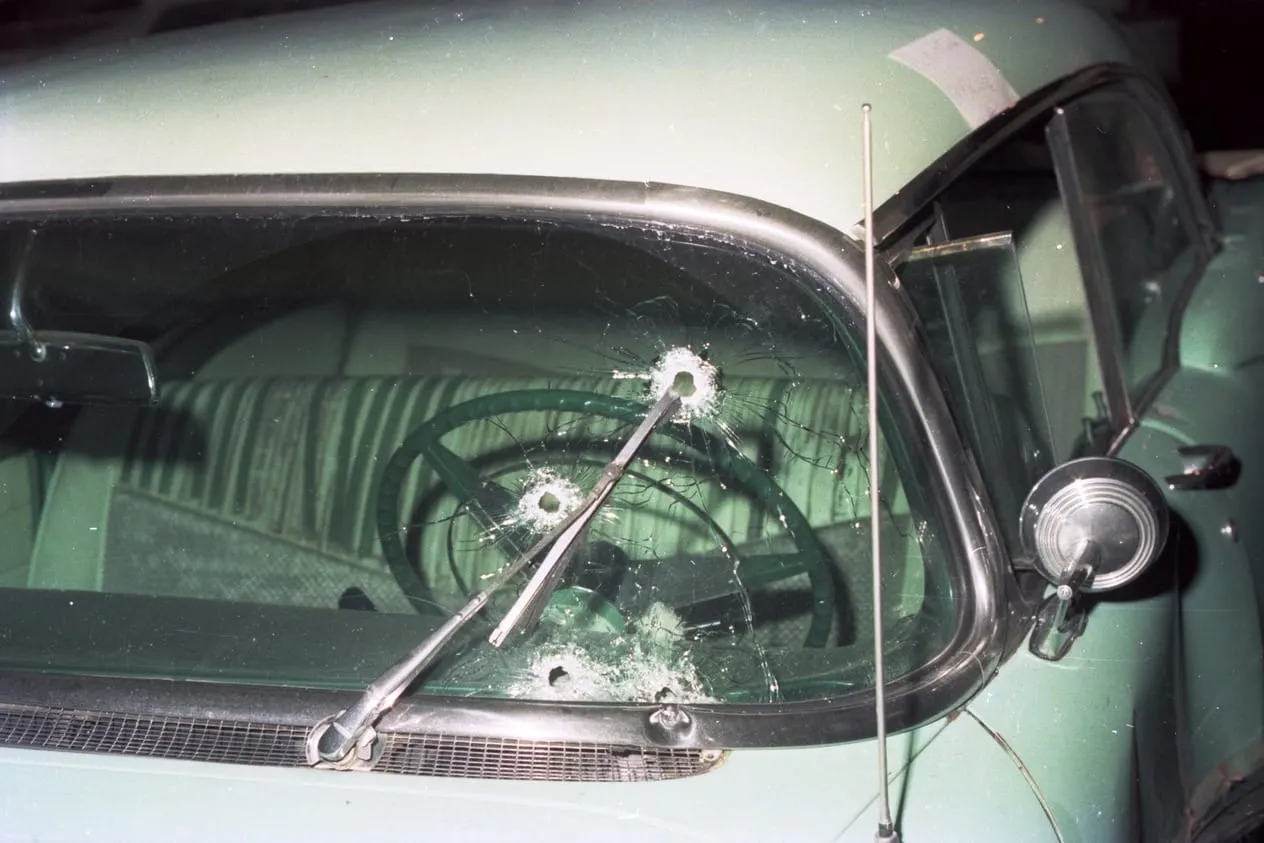
The Buick was towed to the basement of Central Precinct to dry before it could be processed. There were four apparent bullet holes in the windshield, one in the cowling grill below it, and two in the left rear door window; the rear window was shattered, most of the glass gone. Inside, holes ran through the seat upholstery, the headliner, the padded dash, the center of the front seat back, and the center of the back seat. Under the left front seat sat a bottle of Ripple Pear Wine, full or nearly so, and a spent Sears 30-30 casing. A live Sears 30-30 cartridge lay on the floor. There was a green stocking cap between the right door and the passenger seat, a pink knit cap under that seat, and an empty brown paper sack on the right front floorboard. In the trunk, with two tires, jumper cables, a fan belt, a Crescent wrench, and a 1956 Buick shop manual, was the cardboard carton the rifle had been sold in, serial number 3875243 on the box, with a Sears price label reading $109.99. The rifle box, the sack, and a tape deck from the car were checked for latent prints, and every result was negative.
Crime lab crews then took the car apart for its lead: a bullet and copper jacket between the windshield and dashboard near the driver's door, copper jackets in and behind the front-seat upright, lead bullets from the rear floor, from under the headliner above the rear window, from behind the rear seat. At Emanuel Hospital a fragmented bullet was turned over, lead and copper jacket with green cloth embedded in it, and investigators wanted it compared with the green sweatshirt Menefee had been wearing.
The night of the shooting, a deputy medical examiner told police that Menefee had two gunshot wounds, both to the right arm: one had fractured the bone and stopped under the skin, the other had passed into the chest cavity. The postmortem found more. Dr. Larry V. Lewman recorded two entrance wounds in the upper right arm near the shoulder, one bullet just inside the skin of the arm, another passing through the arm and into the right chest; a third entrance wound in the upper left back near the base of the neck; and a fourth wound on the left back, a graze that did not enter the body. Three bullets came out of the body, from the chest, the right arm, and the peritoneum. Lewman held them temporarily and was to contact the chemist George Matsuda when they could be released. On the cause of death he said it plainly: "the cause of death was a bullet wound to the heart."
The laboratory matched what it could. One bullet from the car matched test-fires from Officer Harvey's Smith & Wesson, and so did one of the copper jackets. Two other jackets matched Sergeant Easterday's revolver. One bullet matched the Winchester itself. The bullet recovered from Menefee's right arm matched a test round from Officer Taylor's revolver. His clothing showed bullet holes at the right arm, chest, collar, and back; two holes in the back, the laboratory reported, could not be accounted for and were possibly made by a bullet found at the hospital in the clothing. And there the narrowing stopped. Nothing in the laboratory's surviving comparisons ties any firearm to the bullet taken from Menefee's chest, or to the wound Lewman named as the cause of his death.
The Verdict and the Rifle Left Behind
Deputy District Attorney Mike Frunk presented the case to the Multnomah County grand jury. It returned no indictments. It held that the officers involved had committed no negligence or misconduct, and it ruled the death of Charles E. Menefee justifiable. The officers were cleared the way they had fired: together, as a group. The jurors had before them a night in which, by the officers' own counts, somewhere between six and a dozen shots answered one, and no two of those counts matched. Which gun put the bullet in Menefee's heart, the finding did not say, and no laboratory comparison ever had. In the Police Bureau's ledger, case 74-92843 stayed classified as attempted murder, its status marked exceptional.
The family came for what was left. Two days after the shooting, Detective Blodgett released Charles Menefee's wallet and its contents, miscellaneous identification and two one-dollar bills; Ray R. Menefee signed for it. Robert Menefee asked for the apartment-house key that had been in his son's custody, and police turned the keys over against a handwritten receipt. In January another release went to Robert Menefee Jr., and later Officer Perry got his clothes back: one wool jacket, one undershirt, one T-shirt.
Sandra and Winfield Menefee appeared at the detective office and asked permission to see their brother's 1956 Buick. At the police garage they took numerous photographs of it and asked when it could be released; Winfield asked which towing company had brought it in. The car was to go to Reverend Menefee, or to whoever the family designated, once the processing and the photographs were done.
The rifle was different. Michael N. Schrunk of the district attorney's office instructed that the .30-caliber carbine used in the shooting not be released to any of the involved parties. The office later stated that it had no further need for the weapon and recommended disposition under City of Portland Ordinance No. 139057. Detective Blodgett suggested the Winchester be held a reasonable length of time, so that the Menefee family could contest the decision. Reverend P. L. Menefee, at the house on Northeast Mallory, requested its release.
In February 1975, District Attorney Harl Haas answered him. The letter concerned a Winchester Model 94, .30-30 lever action, serial number 3875243: the rifle bought at Sears six weeks before the shooting, the one Robert Menefee had once carried home and kept until Charles recovered it, the one whose empty cartridge Detective Benson had found under the firing pin. Its seizure and disposition, Haas wrote, fell under Section 14.32.110 of the Portland City Code, enacted by the same ordinance the office had already invoked. The rifle, he stated, had been used unlawfully in an assault in the first degree on a police officer. A Circuit Court Deputy named Michael D. Schrunk signed the letter on the district attorney's behalf.