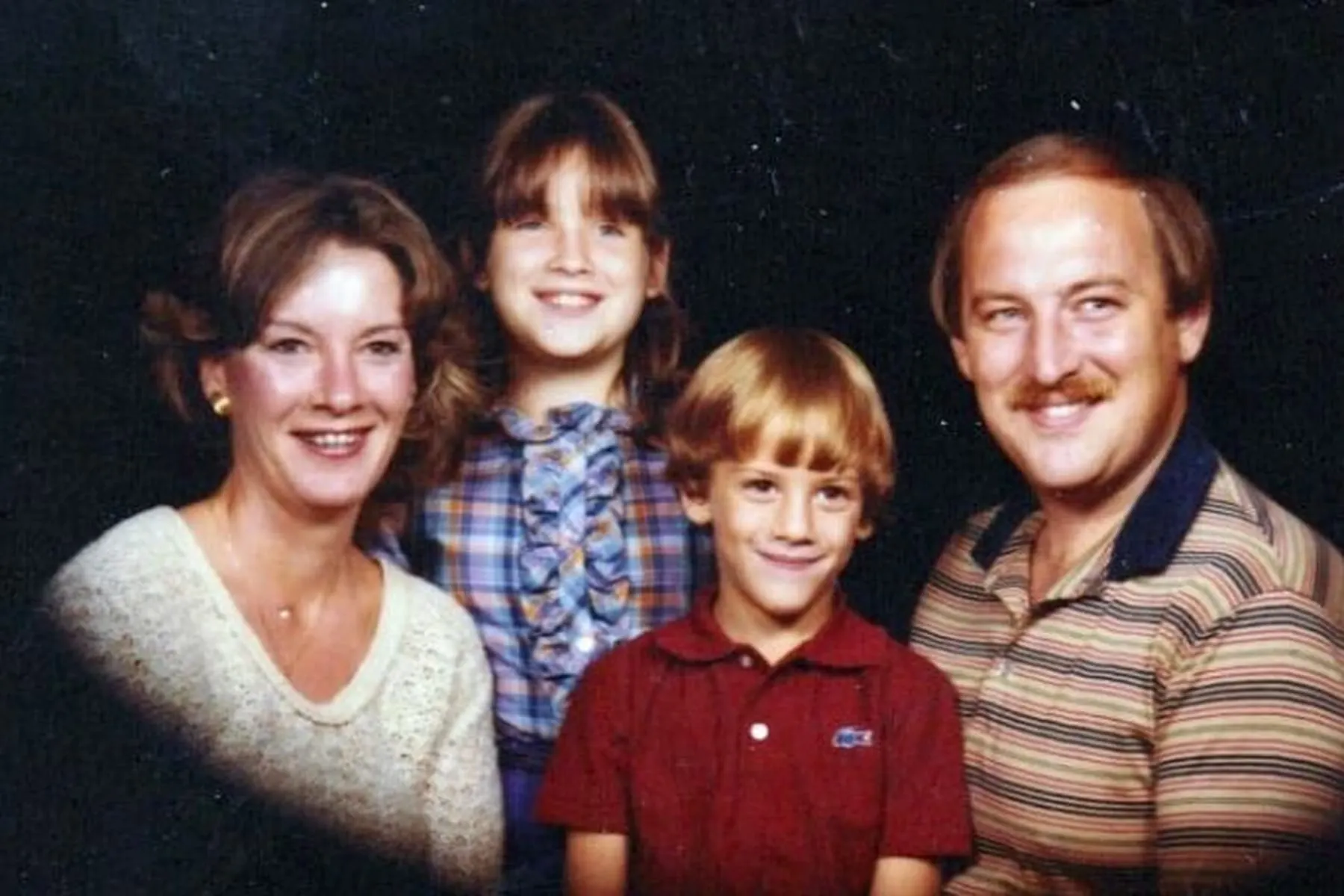
The Harris Family Before the Alarm
The lift is dated December 24, 1989, and marked in an examiner's shorthand: coffee cup, located on the coffee table, family room, with TV. The fingerprint on it belonged to Dolores Elaine Harris. She was forty-one years old, and the cup was hers, in her own family room, and the day after her house burned a technician was dusting it for prints. Out of that one notation a room assembles itself: a coffee table, a television, a cup set down where a person sets a cup down.
She is all through the record of her own house. Two of her fingerprints came off a lift marked "158 mirror." Another lift, marked only "V-1," held one more. The print from the coffee cup turned up again on a duplicate lift taken from the same cup. A lift is how a print leaves a house, carried off on adhesive with a handwritten note saying where it had been, and the notes on hers read like a walk through her own rooms.
There was a lift from the garage as well, marked "GAS CAN GARAGE DH #2," and the fingerprint on it was identified as hers. A can of gasoline in a family garage is as ordinary a place for a woman's fingerprint as the cup on her coffee table.
Marc was eleven, the younger of the two children. Four of his fingerprints came off a single lift marked with his name. One more lift carried his thumbprint, and an examiner took the trouble to establish which thumb it was: the right, not the left. It is the kind of precision the record spends on an eleven-year-old only after the reason for precision has arrived.
Warren Anthony Harris was thirty-nine, Dolores's husband, the father of the two children. His fingerprint was identified in a photograph marked "WAH #2," attached to a check. A check is the paper trail of a working adult, and it is nearly all the examiners kept of him.
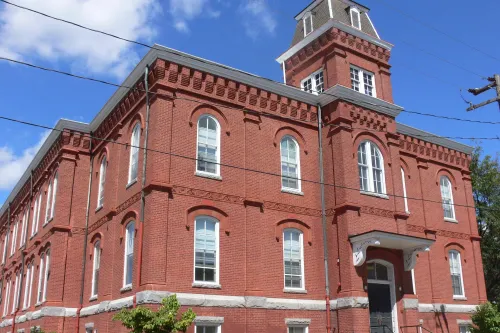
They lived at 1886 Ellis Hollow Road in the Town of Dryden, near Ithaca, New York. On December 23, 1989, the family was there, in Dryden, at home. Dolores's name was on a credit card too, and within hours of what happened in that house, someone else would be signing it.
Shelby, the elder child, was fifteen. In everything the examiners handled she appears as an age, an older sister, and, afterward, a fingerprint card marked deceased. When the family's prints were later needed for comparison, what could be sent were cards taken from the dead: one for Shelby, one for Dolores, one for Warren, each marked deceased, and a fingerprint card for Marc filed beside them. What the investigation kept of the family, while it hunted the people who destroyed it, was this: their ages, their places in one another's lives, and their prints on the things they had touched.
On December 23, 1989, all four were killed in that house. They were tied up. Their heads were covered with pillowcases. Each was shot in the back of the head. Then they were doused with gasoline and set on fire.
That morning an alarm came in from 1886 Ellis Hollow Road, and State Police Trooper John J. Beno responded. He rang the doorbell. No one answered. He entered through a garage door, found the house full of smoke, and radioed his barracks for help.
What Was Found on Ellis Hollow Road
In the master bedroom Beno located a burned body. It was later identified as Shelby Harris, the fifteen-year-old. Officers and firefighters found three more bodies in another upstairs bedroom: her father, her mother, her brother. All four had died of gunshot wounds. Shelby had been sexually assaulted.
Law enforcement officials theorized that whoever murdered the family had set the fire to destroy evidence. A metal gasoline can was recovered from the scene, and investigators suspected that gasoline from it had been used as the accelerant. More than fifty investigators were eventually assigned to the case.
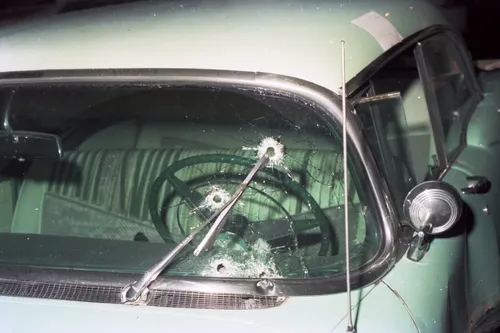
Outside, Beno had found one set of vehicle tracks leading away from the garage and across the lawn. The family's van was located in a bank parking lot at East Hill Plaza, about five miles west of the house, and investigators believed it had been the getaway vehicle after the fires were set.
H. Dean Sutphin, a professor, lived on the road between, roughly 3.9 miles west of the Harris home and a mile east of the lot where the van turned up. He told the State Police that at about 6:50 that morning he had seen a slow-moving van approaching his driveway from the east. The driver, he said, was a light-skinned Black male wearing a stocking cap. Beside him was a woman, light-skinned, darker than the driver, who appeared older than he was.
The credit cards moved fast. Police learned that attempts had been made to withdraw money from the victims' accounts within hours of the murders, and that the family's cards had been used in the same window. Within hours of the crimes at the house, Shirley Kinge forged Dolores Harris's name to one of those cards. She went shopping with her son. She used the card to buy personal items at shopping malls around central New York, and she possessed and used it within hours of the homicides being discovered.
Calls came in identifying Shirley Kinge as matching the description of the woman who had used Dolores Harris's credit card, and police identified her as a potential suspect on the strength of them. By the account a court later credited, she had been identified from composite sketches before any fingerprint entered the case. She was fifty-four and worked at the Peregrine House, a bed-and-breakfast in Ithaca. The State Police learned she cleaned houses and other premises for a living, and that she had once worked for the man who developed the area where the Harris home stood. She lived on one side of a duplex at 520 Etna Road in Dryden; her son Michael Kinge, thirty-three, lived on the other side with his girlfriend, Joanna White, and their child. An informant tipped police that Michael Kinge was the killer, and the investigation came to assert that mother and son together had committed the crimes against the Harris family.
Sutphin's woman in the passenger seat had helped point the way, and he went further: he identified Shirley Kinge herself as the passenger of the van he had seen near the victims' home. Then the sighting began to move. He later said it might have happened between 7:10 and 7:30, not 6:50, and that he could no longer definitively state he had seen the particular occupants he had described. The passenger he had rendered in three careful gradations of complexion became a passenger he could not say he had seen at all. Shortly before Shirley Kinge was arrested, he had essentially retracted the identification.
On January 30, 1990, State Police Investigator David Harding checked into the Peregrine House as a paying guest, undercover, and met with Shirley Kinge. On February 3, Harding reported that he had matched two latent fingerprints from the metal gas can found at the murder scene to her fingerprints.
The Prints That Changed the Case
The can had a history by then. Logged as Item 11, a key piece of evidence from the scene, it had been processed with super glue and dusting, and on December 26, three days after the murders, Harding reported to his senior investigator, McElligott, that he could locate only three latent fingerprints on it, all very faint, all of poor quality, and that they could not be lifted without likely being destroyed.
A Kodak representative tried to enhance and photograph them with oblique lighting and failed. The can went to the Statewide Automated Fingerprint Identification System, which produced nothing usable. McElligott later recalled that he stopped pursuing the gasoline-can fingerprints because he was "beating a dead horse."
Then came the night at the Peregrine House, and three days after meeting the woman the investigation suspected, Harding reported that he had obtained two latent prints of sufficient quality from that same can and matched them to Shirley Kinge. The State Police now had what a court would later describe as direct evidence placing her inside the Harris home.
A search warrant for the Etna Road duplex was obtained, based in part on the fingerprint information. On the morning of February 7, Kinge was taken into custody, and Senior Investigator Chandler and Investigator George Clum interviewed her for about seven hours. She admitted using a credit card that belonged to one of the victims and told police she had received the stolen property from her son. She adamantly denied ever having been in the Harris home. She was arraigned that day and indicted on numerous charges. The charges said she had helped her son burn down the Harris family home after the murders, and that she had used credit cards stolen from the family.
Chandler had sat across from her through those seven hours, and he was skeptical that she had been at the crime scene at all. He remarked that, without the fingerprint evidence, he would believe she had not been in the house, and Clum, who testified later to the remark, agreed with the analysis. The prints were carrying everything.
The people around the fingerprints kept noticing things. McElligott testified that he became suspicious when Harding reported finding two usable prints, and that his discomfort with Harding grew. Investigator Charles Porter expressed concerns to him about how Harding handled physical evidence. Investigator Lishansky testified that McElligott approached him during the investigation to discuss concerns about the legitimacy of the prints Harding had purportedly lifted from the gas can.
After a preliminary hearing at which Harding testified, McElligott saw him carrying Kinge's fingerprint card in his pocket, with no evidence tag and no evidence bag, in violation of State Police protocols on preserving evidence. McElligott confronted him. He made no official report of it, and he took no further action to ensure the evidence was properly handled.
Before trial, an investigator from another troop, highly experienced in fingerprint identification, was asked to validate the prints. He was not called as a witness. Lishansky told McElligott the reason: the man "d[id]n't like the prints." McElligott did not ask why. Chandler testified that McElligott told him he was disturbed by Harding's testimony about the location of the fingerprints, and that when he asked whether Harding had done something wrong, McElligott answered that the way Harding had testified was "kind of screwed up."
Investigator Martin E. Hughes, trained in fingerprint classification, identification, and processing, met with District Attorney George Dentes to help prepare for trial and told him there were several problems. The prints had not been photographed before being lifted, though State Police protocol required photographing a print first, precisely to verify where it came from. The can bore no markings identifying the prints' origin. The lifters had been cut down from their original size, and fingerprint expert Vincent Rossetti testified that cutting a lifter down makes the origin of a print harder to determine. Hughes took the problems to Lieutenant Craig Harvey, who was responsible for overseeing the investigation. During the trial itself it was learned that Harding had wiped the gas can down, removing any evidence that fingerprints had ever been on it.
Harding testified that he had lifted two latent prints from a gas can found in the Harris home, and that the prints were Shirley Kinge's. Her account never changed: the cards, yes; the house, never. In November 1990 a jury convicted her of first-degree burglary, third-degree arson, second-degree forgery, hindering prosecution in the first and second degrees, and criminal possession of stolen property. On January 30, 1991, one year to the day after Harding checked into the Peregrine House, she was sentenced to 18 to 44 years in prison.
When the Gas Can Could Not Hold the Story
In the summer of 1992 the gas can went to the FBI Laboratory, and it did not go alone. On July 6 the laboratory took personal delivery of three cans, two metal two-gallon and one plastic five-gallon, still tagged as People's Exhibits 87, 264, and 89 from the trial. With them came the latent lifts, three fingerprint cards and two palm prints of Shirley T. Kinge, a fingerprint card for Marc Harris, the deceased cards for Shelby, Dolores, and Warren, eight photographs of a gas can, and three strips of 35-millimeter negatives of a latent print on a gas can. One of the submitted cards carried a second name: it belonged to Anthony Turner, also known as Michael A. Kinge. The submitting agency was the New York State Police; the examinations had been requested by letters that July.
The laboratory's worksheet described the matter as a homicide and rape investigation, with "arson" written in by hand. It listed Michael A. Kinge and Shirley Kinge as the suspects, and Warren, Dolores, Shelby, and Marc Harris as the victims.
The evidence traveled because of a job application. In early 1991 David Harding had interviewed for employment with the Central Intelligence Agency, and during a polygraph interview he admitted that he had fabricated fingerprint evidence and committed perjury in a murder case and in other cases. By 1992 the admission had surfaced, and the U.S. Department of Justice began investigating claims that New York State Police troopers, Harding among them, had falsified fingerprint evidence.
The question sent with the cans was narrow. Information had developed that the two identified prints attributed to Shirley Kinge might not have originated from the gas can at all. The laboratory was asked to compare imperfections, scratches, and trace debris on the lifts against the can, and to determine whether super glue or other debris on the lifts was common to it.
The prints were hers; that much held. An examiner identified latent fingerprints on the lifts marked "metal gas can," dated December 23, 1989, as Shirley T. Kinge's. What did not hold was the claim underneath: the examiner could not determine whether the lift had originated from any of the three gas cans. And on one of the lifts, the date told its own story. The entry "12/23/89" had been altered; it had previously read "__/__/90." What appeared to be a letter "g" sat in the area of the "89," and the original month and day could not be recovered. In October, laboratory photographers were asked for pictures showing the alterations, and the photographs were made. The murders were in December 1989. Harding met Shirley Kinge in 1990.
The can itself had been worked over. A latent fingerprint visible in two photographs marked "gas can," and in three strips of negatives, was identified as Dolores Elaine Harris's. Markings visible in those photographs were also present on the first can. The print itself was no longer on the can. Scratches indicated a metal object had been used to scratch it off, and two more latents on the same can bore scratches indicating attempts to destroy them. The lift from the garage marked with her initials, the one that had seemed so ordinary, was determined not to have originated from the marked area of the second can. One lift genuinely had come from the first can, and the laboratory could say so because of a paint particle on it, a chip red on one side and yellow on the other, microscopically like the can's red-over-yellow finish in color and layer structure. Even there the examiners kept their footing: the chip could have originated from that can or from another source with matching paint.
What remained on the cans was thin. Two latent prints of identification value were still present on the first can. The second held a print from the tip or side of a finger, an impression that was either a fingerprint or a palm print, and one palm print of identification value. The plastic five-gallon container held nothing of value at all. Reprocessing all three produced no further prints and nothing additional of significance, and the examiner noted that more complete and legible prints of the people being compared would be needed for conclusive comparisons of some latents.
The lifts from inside the house told a steadier story. Twenty-four latent fingerprints of identification value lay on fourteen lifts and on a piece of paper bearing prints covered with transparent tape, and the identifications ran back to the family: the coffee cup, the mirror, the check. One impression, on a gas can lift, matched no one at all: not Shirley Kinge, not Michael Kinge, not Warren, Dolores, Marc, or Shelby Harris.
Some questions the laboratory declined to chase. It conducted no hair or fiber examinations in the case. It ran no gasoline examinations on the four lifts. Its Materials Analysis Unit determined that infrared spectrometry would not detect cyanoacrylate fumed onto a surface the way fingerprint processing leaves it, so no further testing was done on that point. Of one requested examination the laboratory reported flatly that no meaningful forensic results could be determined.
In a related identification that summer, an analyst determined that a lift described as taken from a sink inside a residence had actually been taken from a beer bottle found outside it. Part of the bottle's label was torn off next to where the print had been. The lift had been cut shorter than standard, apparently to remove pieces of label stuck to it, though microscopic examination found no label material remaining on it. The analyst told a New York prosecutor, who asked that the evidence go back to the State Police.
The FBI's determination, in the end, was plain: Harding had lifted Shirley Kinge's latent prints during the investigation and planted them on the gasoline can. He had met her undercover after she was identified as a suspect, and, in the words a court later used, presumably obtained from her the items her fingerprints could be lifted from. The laboratory's final latent-print report was dated December 11, 1992.
By then the courts had moved. On August 25, 1992, the judgment of conviction was vacated; she was granted a new trial and released on bond that month. It was disclosed that Harding and other members of the State Police had fabricated evidence in other investigations, and it was alleged that Harding and Lishansky had given perjured testimony in the proceedings against her. District Attorney Dentes put the state of his case into an affidavit: there was "no reliable evidence" that Kinge was at the Harris home, and the prosecution "lacks proof" of her guilt of those crimes. On November 9, 1992, he moved to dismiss the entire indictment, and it was dismissed.
The Cost of a False Place in the House
The morning Shirley Kinge was taken into custody, officers were also at the duplex on Etna Road with the search warrant that covered both residences. Michael Kinge confronted them with a loaded weapon. Gunfire was exchanged, and he died of gunshot wounds. A gun found in his apartment was later identified as the murder weapon. No attempt was ever made to reinstate criminal charges against Shirley Kinge for crimes related to the Harris family murders, and through every proceeding against her she denied participating in or knowing about what had been done at the Harris home.
She served two and a half years of the 18-to-44-year sentence. In November 1992 she pleaded guilty to misdemeanor forgery. Harding pleaded guilty to perjury, admitted planting evidence in her case and in others, and was sentenced to four and a half years in prison. Governor Mario Cuomo ordered an investigation into his conduct and the alleged misconduct of other State Police members, appointing Nelson E. Roth as special prosecutor; Roth's report was published in 1997.
In the Court of Claims, the fabrication was measured against everything else the case had held. Dentes, who had prosecuted her, testified that her use of Dolores Harris's credit card would by itself have justified prosecuting her for the Harris home crimes, and would have been sufficient to sustain a conviction under the recent-exclusive-possession rule. The court concluded otherwise. Probable cause had existed for her arrest, grounded in her use of the card within hours of the homicides. But without Sutphin's retracted identification and the fingerprints, the card was the only significant evidence tying her to the house, and without the fabricated prints there was no probable cause linking her to those specific crimes and she would not have been prosecuted for them.
Harding's own conduct was found to be outside the scope of his employment, so the case against the State ran through the men above him. The court found that McElligott had directly observed Harding mishandle crucial fingerprint evidence, failed to report the misconduct, and failed to see the evidence secured and preserved. McElligott testified that he had been unaware of the protocol violations, and acknowledged that the identification unit Harding belonged to was not really supervised by anyone. Hughes testified that the deficiencies in the evidence handling were entirely consistent with a fabricated fingerprint. The court found that minimal supervision would have prevented the fabrication, that McElligott's negligent supervision gave Harding ample opportunity to manufacture the prints, and that it amounted to a blatant disregard of her rights sufficient to satisfy the actual-malice element of malicious prosecution. The State was held liable for negligent supervision and malicious prosecution, findings an appellate court saw no basis to set aside, observing that courts guard the guardians who enforce the laws.
The same court did not make her blameless. It found she had willingly participated with her son in a scheme to use the Harris family's credit cards, forging Dolores Harris's signature and buying personal items for her own benefit within hours of the burglary, the murders, and the arson. It declined to award damages for harm to her reputation, finding that her own conduct had caused that harm.
She testified that the arrest and prosecution left her with depression and mental anguish, that she became fearful of being recognized in public, and that she could not obtain full-time employment. A friend and former employer testified to the changes in her personality and appearance after the arrest, the conviction, the imprisonment, and the release. The court awarded $250,000 for mental anguish, emotional distress, and loss of liberty during a prosecution and two and a half years of incarceration for what it described as crimes she did not commit, and the award was affirmed on appeal. In 2009, nineteen years after the jury's verdict, the State of New York paid her $286,312 in compensation.
Shirley Turner Kinge died in 2015. She was eighty years old.